



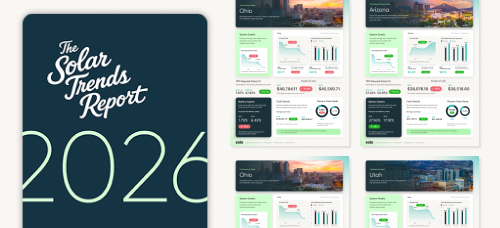
An end-of-year snapshot of how policy, financing, and equipment dynamics reshaped the residential market.
2025 End-of-Year Summary
2025 was defined by the wind-down of the Section 25D Residential Clean Energy Credit and the industry’s accelerated shift toward third-party ownership (TPO).
The lack of a 25D phase-out pulled demand into the first three quarters of the year, leaving Q4 focused primarily on execution rather than new customer acquisition.
As loan APRs rose into the 7–8% range, customer-owned solar economics weakened, reinforcing the move toward Section 48E-backed TPO structures.
Storage proved the most resilient segment, supported by state incentives, NEM 3.0 dynamics, and early virtual power plant programs.
At the same time, Foreign Entity of Concern (FEOC) compliance reshaped equipment procurement, favoring domestic content and tighter supplier relationships.
Market Performance at a Glance
The year-end slowdown arrived as expected, confirming the close of the extended 25D sales cycle.
November permits tracked flat to slightly down month over month, while December point-of-sale data shows a clear shift toward third-party ownership.
Installers that finalized TPO partnerships in Q4 are reporting more stable early Q1 pipelines, while late movers face a sharper reset.
Geographic divergence is emerging, with high-rate and storage-friendly states showing greater resilience.
What it means for solar teams: This is not a demand shock—it’s a structural reset. Teams that prepared for TPO and refined market focus in Q4 are already seeing the benefits in early 2026.
Financing Trends: High APRs Reshape the Conversation
Consumer financing has structurally shifted.
| Median loan APRs stablized between 7.5-8 percent. |
| Cash and loan paybacks are far less compelling without the 30% tax credit. |
| TPO monthly payments are now competitive on economics alone. |
How to adjust your sales conversations: Lead with monthly payment certainty, not ownership. With loan APRs near 8 percent and no tax credit, TPO now offers the clearest economic case.
Federal Policy: Deadlines Passed, Compliance Begins
Section 25D officially ended December 31, with Q4 focused almost entirely on executing the existing pipeline.
Beginning in 2026, residential TPO projects fall under Section 48E and must meet FEOC compliance requirements, including 40% non-FEOC content. Installers that secured compliant equipment in late 2025 hold a clear advantage.Operational reality: Equipment access—not demand—will constrain growth for unprepared teams in early 2026.
TPO is now the primary residential solar model.
The 2026 market is forecast at 3.5 GW, with TPO projected to capture 69 percent of installations, up from 45 percent in 2025.
December point-of-sale data already reflects this shift, even though final interconnection data still lags earlier cash and loan activity.
Pre-paid leases are gaining traction as a transitional product.
Adoption is accelerating among former cash and loan buyers who want lower upfront costs without long-term ownership risk.
Programs like Nevada BRIGHT’s six-year ownership transfer are helping maintain pipeline flow during the transition, even at lower margins.What teams should do now: Finalize TPO partnerships, retrain reps to sell payments instead of credits, and align equipment strategy to domestic content requirements.
Storage Remains the Bright Spot
Storage continues to outperform solar-only installations.
Storage continues to outperform solar-only installations, with national attachment rates near 40% and significantly higher levels on TPO projects.
Policy tailwinds are strengthening storage economics:
State programs in California, Massachusetts, and Connecticut continue strengthening storage economics, and storage is projected to decline only 11% in 2026 versus 26% for solar.
Why storage matters: Storage is now the most reliable revenue driver in residential solar. It improves economics, offsets lost incentives, and positions customers for emerging VPP programs.
State and Utility Policy to Watch
| California |
| New interconnection documentation effective Nov 1. PG&E proposed higher interconnection fees—watch closely. |
| Nevada |
| Demand charges and 15-minute netting weaken solar-only economics. Storage is essential; Nevada BRIGHT adds flexibility. |
| Illinois |
| CRGA passed with a 3 GW storage target. $20/REC adder proposed. IL Shines capacity doubled. One of the strongest 2026 markets. |
| Massachusetts |
| SMART 3.0 provides stable solar-plus-storage economics. Variable storage adder strengthens system value. |
| New Jersey |
| Proposed 500 MW storage deployment and demand optimization program. |
Strategic takeaway: Policy strength is diverging by state. Focus resources on markets where rates and storage incentives align—Illinois, Massachusetts, California with storage, and Connecticut.
Looking Ahead: December Was the Line in the Sand
2026 will be shaped by higher utility rates, TPO-dominant financing, and tighter equipment and policy constraints—not by tax credit urgency.
Teams that entered the year with TPO capabilities, storage offerings, and FEOC-compliant supply in place are positioned to stabilize in 2026 and benefit from recovery as the market rebounds beyond 2027.
Critical priorities heading into 2026:
Finalize TPO capabilities and partnerships.
Retrain sales teams on payments and utility economics.
Lock in FEOC-compliant equipment allocations.
Refine geographic focus toward resilient markets.